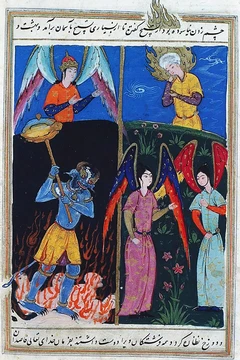
Christianization of saints and feasts
Pre-Christian traditions reshaped into Christian saints and feast days.

Wikipedia / Wikimedia Commons
The Christianization of saints and feasts refers to the process by which pre-Christian traditions, figures, and festivals were adapted or reinterpreted within Christian practice. This includes the incorporation of local saints, the transformation of pagan festivals into Christian feast days, and the occasional borrowing of narrative elements from non-Christian religions. The phenomenon is documented across various cultures and periods, reflecting both continuity and change in religious observance.
- field
- Religious history, hagiography, liturgical studies
- known_for
- Adaptation of pre-Christian feasts and figures into Christian calendars
- nationality
- Various (Roman, Celtic, Germanic, etc.)
- era
- Late Antiquity to Middle Ages
Lore & Background
Historian Peter Brown argued that ancient cults of pagan gods cannot be equated with later cults of saints, though churchmen like Caesarius of Arles deplored customs such as prolonged drinking toasts in honor of saints. Some saints have been treated skeptically due to lack of historical evidence or resemblance to pre-Christian deities; a few were removed from the Calendar of Saints after investigations, while others like Brigid of Kildare retained their position despite doubts. The legend of Barlaam and Josaphat was derived from the life of Siddartha Gautama (the Buddha), with the name Josaphat coming from the Sanskrit Bodhisattva; this story was placed in the Orthodox calendar on 26 August and in the Roman martyrology on 27 November, and was also translated into Hebrew as Ben-HaMelekh ve HaNazir.
Reader's Guide
The Christianization of feasts involved aligning Christian celebrations with pre-existing seasonal festivals. Saint Valentine's Day on 14 February commemorates three martyrs named Valentinus; its romantic customs arose in the Middle Ages, with some scholars claiming origins in the Roman Lupercalia, though others find this hypothesis unconvincing and note no written record of Pope Gelasius intending a replacement. Easter, the oldest Christian feast, is connected to the Jewish Passover; the English term derives from Ēostre, a Teutonic goddess. The Greater Litanies of St. Mark's Day (April 25) are a continuation of the Roman Robigalia. Walpurgis Night (April 30–May 1) coincides with older May Eve festivals like Beltane, with bonfires and traditions traceable to pre-Christian celebrations. Saint John's Day (June 24) was set by the 4th-century church to balance the summer solstice, with John the Baptist's birth symbolizing the decrease of the sun. All Hallows (October 31–November 2) incorporates Samhain traditions of commemorating the dead, and was moved to this date by Pope Gregory III. Christmas on December 25 is widely thought to appropriate the Roman winter solstice festival Dies Natalis Solis Invicti, instituted by Emperor Aurelian in 274; early Christian writers like John Chrysostom and Augustine linked Christ to the Sun of Righteousness.
Did You Know?
- The legend of Barlaam and Josaphat was derived from the life of Siddartha Gautama (the Buddha) and was placed in the Orthodox calendar on 26 August and the Roman martyrology on 27 November.
- The English term 'Easter' derives from Ēostre, a Teutonic goddess of the rising light of day and spring, according to the Venerable Bede.
- The Greater Litanies of St. Mark's Day (April 25) are a continuation and adaptation of the Roman agricultural festival Robigalia.
- Christmas on December 25 is widely thought to appropriate the Roman winter solstice festival Dies Natalis Solis Invicti, instituted by Emperor Aurelian in AD 274.
Frequently Asked Questions
Who is Christianization of saints and feasts?
It is not a single supernatural entity but rather the broad historical process by which pre-Christian deities, folk figures, and seasonal festivals were absorbed and reinterpreted into the Christian liturgical calendar. Think of it as the mechanism behind why so many saints' days land on dates that originally belonged to pagan observances.
What are Christianization of saints and feasts's powers or role?
Its 'power' is essentially one of cultural transformation: local pagan rites, seasonal celebrations, and mythic narratives were recast as hagiographic stories or feast-day observances so that existing community practices could continue under a Christian framework. It functioned across Roman, Celtic, Germanic, and many other cultural traditions.
How does Christianization of saints and feasts's story end?
There is no single dramatic finale; the process tapered off gradually as the Middle Ages gave way to the early modern period and the liturgical calendar became fully standardized. By that point, most major pre-Christian festivals had either been fully absorbed, suppressed, or survived only as faint folkloric echoes within saint's-day customs.
Why is Christianization of saints and feasts important to fans of the subject?
It explains the layered, hybrid nature of nearly every saint's legend and feast day, showing that what looks like a purely Christian narrative often carries structural DNA from older seasonal or mythic cycles. Understanding this lens lets readers trace continuity and change across centuries of religious observance.
Which eras and cultures does Christianization of saints and feasts span?
The phenomenon is documented from Late Antiquity through the Middle Ages, with active examples in Roman, Celtic, Germanic, and numerous other regional traditions. Its footprint is so wide that scholars in religious history, hagiography, and liturgical studies all treat it as a cross-cultural pattern rather than a single localized event.
More in part-1
Spotted an error? Know more?
This is a living reference — every entry is fact-audited, and reader corrections feed straight into our audit queue. Suggest an edit · See this site's audit record