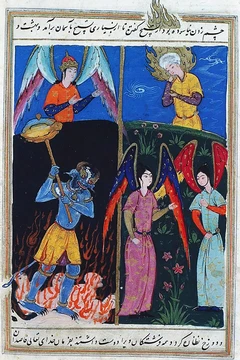
Dhu'l-Kifl
Islamic prophet of unknown identity, often linked to Ezekiel.

Wikipedia / Wikimedia Commons
Dhu'l-Kifl (Arabic: ذُو الْكِفْل, romanized: ḏū l-kifl, lit. 'Possessor of the Portion') is an Islamic prophet mentioned twice in the Qur'an. His identity is unknown, though he is most commonly identified with the Hebrew Bible prophet Ezekiel. He is described in the Qur'an as a man of the 'Company of the Good' and is believed to have been raised by Allah to a high station. Classical commentators such as Ibn Ishaq and Ibn Kathir speak of him as a prophetic, saintly figure who remained faithful in daily prayer and worship.
- Name
- Dhu'l-Kifl (also Dhu al-Kifl, Dhu l-Kifl, Dhul-Kifl, Zu al-Kifl, Zul Kifl, Zu l-Kifl)
- Known For
- Islamic prophet; mentioned in the Qur'an as among the righteous
- Mentioned In
- Qur'an (twice, in lists of prophets)
- Common Identification
- Ezekiel (Hebrew Bible prophet)
- Other Proposed Identifications
- Joshua, Obadiah, Isaiah, Gautama Buddha
- Associated Tomb
- Ergani province, Diyarbakir, Turkey (Makam Dağı); also al-Kifl, Iraq
Lore & Background
Dhu'l-Kifl is believed to have been a prophet raised by Allah to a high station. He is chronicled in the Qur'an as a man of the 'Company of the Good.' Although little is known from other historical sources, classical commentators like Ibn Ishaq and Ibn Kathir describe him as a prophetic, saintly man who remained faithful in daily prayer (ṣalāh) and worship (ʿibāda).
The name Dhu'l-Kifl literally means 'the possessor of kifl,' with kifl being an archaic Arabic word meaning 'double' or 'duplicate,' from the root ka-fa-la meaning 'to double' or 'to fold.' It was also used for a fold of cloth. The name is generally understood to mean 'one of a double portion.' Some scholars have suggested it means 'the man with the double recompense' or 'the man who received recompense twice over,' possibly a title for Job.
A tomb in the Ergani province of Diyarbakir, Turkey, is believed by some to be the resting place of Prophet Dhu'l-Kifl. It is located 5 km from the city centre on a hill called Makam Dağı. Additionally, a shrine in the town of al-Kifl in southeastern Iraq is associated with him, originally a Jewish site for Ezekiel that was later converted to an Islamic shrine.
Reader's Guide
Dhu'l-Kifl's significance lies in his inclusion among the prophets of Islam, despite his uncertain historical identity. The Qur'an mentions him twice in lists of righteous prophets, alongside figures like Ishmael, Enoch, and Elisha. This placement affirms his status as a prophetic figure in Islamic tradition, even though no detailed narrative of his life is provided. The name itself—'Possessor of the Portion'—has prompted various interpretations, from a literal double portion to a title for Job or Ezekiel. The identification with Ezekiel is the most common, supported by the existence of a shrine at al-Kifl, Iraq, which was originally a Jewish pilgrimage site for Ezekiel. The Ilkhanid ruler Öljaitü acquired guardianship of the tomb from the Jewish community in 1316 (715–16 AH) and added a mosque and minaret. Later, a wealthy Jew named Menahem ibn Danyal converted it back to a Jewish site. This history illustrates the shared reverence for the figure across religious traditions. Dhu'l-Kifl's legacy endures as a symbol of faithfulness and righteousness, though his precise identity remains a matter of scholarly debate.
Did You Know?
- Dhu'l-Kifl is mentioned twice in the Qur'an, always in lists of prophets including Ishmael, Enoch, and Elisha.
- The name Dhu'l-Kifl literally means 'possessor of the portion,' with 'kifl' meaning 'double' or 'duplicate.'
- A tomb in Ergani province, Diyarbakir, Turkey, is believed by some to be his resting place.
- The town of al-Kifl in Iraq contains a shrine originally associated with the prophet Ezekiel, later renamed for Dhu'l-Kifl.
Frequently Asked Questions
Who is Dhu'l-Kifl?
Dhu'l-Kifl is an Islamic prophet referenced twice in the Qur'an, always within lists of righteous figures. His true historical identity is never explicitly named, though the majority of classical commentators equate him with the Hebrew Bible prophet Ezekiel.
What is Dhu'l-Kifl's supernatural role or power?
He is characterized as a member of the 'Company of the Good' whom Allah raised to a high spiritual station. Classical sources such as Ibn Kathir emphasize his defining trait as an unbroken commitment to daily prayer and worship, marking him as a model of prophetic devotion.
How does Dhu'l-Kifl's story end?
The Qur'an offers no narrative of his death or final act; instead, his story is essentially one of quiet, persistent righteousness preserved in prophetic roll-calls. His legacy continues through veneration at physical shrines rather than through a dramatic concluding event.
Why is Dhu'l-Kifl important to fans of supernatural saint-figures?
His deliberately ambiguous identity makes him a rare cross-traditional figure, with scholars linking him not only to Ezekiel but also to Joshua, Obadiah, Isaiah, or even Gautama Buddha. This multiplicity of possible origins gives him a unique place in comparative supernatural lore.
Where is Dhu'l-Kifl's tomb or shrine located?
Two main sites are traditionally associated with him: the Makam Dağı hill in Ergani, Diyarbakır province, Turkey, and a locality called al-Kifl in Iraq. Both function as pilgrimage destinations for those who revere him as a saintly prophet.
More in part-1
Spotted an error? Know more?
This is a living reference — every entry is fact-audited, and reader corrections feed straight into our audit queue. Suggest an edit · See this site's audit record