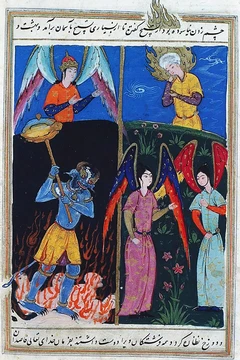
Ognyena Maria
Fire goddess and sister of the thunder god Perun.
Ognyena Maria, whose name means "Fiery Mary," is a fire goddess in Slavic mythology. She is the sister and helper of the thunder god Perun. Her figure comes from a blending of Margaret the Virgin and the Virgin Mary, both of whom were considered sisters of Saint Elias. Among southern Slavs, she is also seen as the sister of a thunder god or saint, and she is linked to rain, the sea, or to Lazarus, as well as to azure flashes of lightning. Her feast day in the Slavic folk calendar falls on July 17 according to the Julian calendar, which is around July 30.
In Belarus, people pray to her for healing from illnesses, reciting a verse that offers troubles to the water in exchange for health.
In Bulgaria, her celebration takes place on July 22, a day meant to prevent fires. A strict ban on housework is observed, as the summer heat in July could easily spark disasters. Anyone who breaks this ban is believed to bring destructive fires upon themselves and their households. Her festival is the culmination of a celebration from July 15 to 22, connected to the Goreshtnitsi Festival from July 28 to 30. As the mistress of snakes, people are also forbidden from using ropes and threads on her feast days, since snakes are said to hide in the underworld during this time. On the first day of Goreshtnitsi, all fires are put out, and no new ones are lit until the third day, when Bulgarians celebrate the fires of the Holy Spirit. Some do this to honor Ognyena Maria's power over fire. Others believe that, as the sister of Saint Elijah, she hides from him on St. Elias' Day to keep him from becoming so delighted that his lightning and thunder destroy everything.
In Russia, she is thought to be the daughter of a sea king. Bored with life in his palace, she fled to land. Her angry father rained down darts of lightning on her birthday, blinding anyone who saw them. Her birthday falls around Trinity Week, also known as Rusalka Week, or St. Elias' Day. People are advised not to swim or bathe in the days leading up to Trinity Week, as mermaids are believed to drown anyone who enters the water. If someone must, they use crosses, garlic, magic charms, and wormwood to ward off the mermaids.
In Serbia and parts of Bosnia and Herzegovina with Bosnian Serb populations, including the Republic of Srpska, Ognjena Marija is usually linked to Margaret the Virgin and, along with Saint Elijah, is c
- field
- Slavic mythology, folk religion
- known_for
- Fire goddess, sister of thunder god Perun, associated with rain, sea, and lightning
- feast_day
- July 17 (Julian calendar, around July 30)
- associated_saints
- Margaret the Virgin, Virgin Mary, Saint Elias
Lore & Background
In Slavic mythology, Ognyena Maria is a fire goddess who is the sister and assistant of the thunder god, Perun. She originates as a conflation of the figures of Margaret the Virgin and the Virgin Mary, both regarded as sisters of Saint Elias. This divinity also appears with southern Slavs, and is usually considered to be the sister of the thunder god/saint. She was also associated with rain or the sea, or with Lazarus (Марина Лазоревая) and azure flashes of lightning.
In Belarus, she is prayed towards for healing from ailments. In Bulgaria, she is celebrated on July 22 as the day she prevents fires; a strict ban is observed on housework to prevent disastrous fires. As the mistress of snakes, people were forbidden from using ropes and threads on her feast days. In Russia, she is considered the daughter of a king from the sea; her birthday falls around Trinity Week or St. Elias' Day. In Serbia and parts of Bosnia and Herzegovina, Ognjena Marija is usually associated with Margaret the Virgin and considered one of the fiery saints. In Ukraine, villagers would pay attention to the lightning in the sky, hoping that on her day this will indicate that God will send rain for their crops.
Reader's Guide
Ognyena Maria holds significance as a syncretic figure blending pre-Christian Slavic fire worship with Christian saint veneration. Her role as sister of the thunder god Perun (later associated with Saint Elias) reflects a common pattern in Slavic folk religion where natural forces are personified and linked to family relationships. The prohibitions on work and fire on her feast days, particularly in Bulgaria and Serbia, demonstrate her perceived power over destructive fires and the community's reliance on her favor for protection. The variation in her feast dates (July 17 Julian, July 22 in Bulgaria) and associated rituals—such as extinguishing fires during the Goreshtnitsi Festival or using charms against mermaids in Russia—highlight regional diversity in Slavic folk practice. Her legacy endures in the continued observance of her feast by some families in Serbia as a Slava (family patron saint day), where she is believed to ensure abundant crop yields.
Did You Know?
- In Bulgaria, a strict ban on housework is observed on July 22 to prevent fires, and anyone who breaks the ban is believed to suffer destructive fires.
- In Russia, Ognyena Maria is considered the daughter of a king from the sea; her father rained down darts of lightning on her birthday, blinding anyone who saw them.
- In Serbia and parts of Bosnia and Herzegovina, families that celebrate Ognjena Marija as their Slava are said to always have the fullest crop yield.
- In Ukraine, villagers would watch for lightning on Ognyena Maria's day, hoping it indicated God would send rain for their crops.
More in part-1
Spotted an error? Know more?
This is a living reference — every entry is fact-audited, and reader corrections feed straight into our audit queue. Suggest an edit · See this site's audit record