Paraskeva Friday
Slavic folk personification of Friday and a saintly figure.
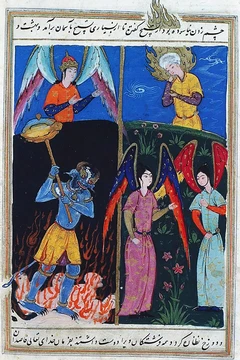
Paraskeva Friday is a figure from Slavic Eastern Orthodox folk Christianity, blending the personification of the day Friday with the cults of two saints: Paraskeva of Iconium and Paraskeva of the Balkans. In popular belief, she is linked to Saint Anastasia of the Lady of Sorrows and Saint Nedelya, who personifies Sunday. Similar day-personifications appear in other cultures, like the Tajik Bibi-Seshanbi, or "Lady Tuesday."
The name *paraskeva* comes from Greek, meaning "preparation for the Sabbath."
Folk depictions of Paraskeva Friday differ from her iconographic image, which shows an ascetic woman in a red *maforiya*. A well-known carved icon from the village of Illyeshi is kept in the Trinity Cathedral of the Alexander Nevsky Lavra in St. Petersburg and is revered as a miracle worker in the Russian Orthodox Church. Wooden sculptures of Paraskeva were common among Russians and neighboring peoples. In 1903, folklorist A. F. Mozharovsky noted that chapels in "foreign areas" held "roughly carved wooden images of Saints Paraskeva and Nicholas," both called *Pyatnits* ("Friday"). A 1908 historical sketch by Svyatsky described these statues as painted wooden figures, sometimes dressed in oriental attire, sometimes in a *poneva* skirt and *lapti* bast shoes, kept in church cabinets where people prayed before them. Popular imagination could also give Paraskeva demonic traits: tall stature, long loose hair, and large breasts thrown over her back, linking her to figures like Dola, Death, and the Rusalka.
For East Slavs, Paraskeva Friday personified the day of the week. She was known as Linyanitsa, Paraskeva Pyatnitsa, Paraskeva Lyanyanikha, and Nenila Linyanitsa. Her feast days fell on October 27 (Paraskeva Muddyha Day) and November 10 (Paraskeva the Flaxwoman), which in the church calendar commemorate Paraskeva of the Balkans and Paraskeva of Iconium. On these days, spinning, washing, and ploughing were forbidden to avoid "dusting" Paraskeva or "clogging her eyes." Breaking the ban was thought to bring disease. The Stoglav Synod of 1551 condemned such superstitions, noting that "false prophets" – men, women, maidens, and old women – went about naked and barefoot, with loose hair, claiming to be Saint Friday or Saint Anastasia and commanding people not to work on Wednesdays and Fridays.
Paraskeva Friday was believed to enforce other Friday prohibitions, like wash
- field
- Folk Christianity, Slavic mythology
- known_for
- Personification of Friday; patron of women's work; associated with prohibitions on spinning, washing, and ploughing on her feast days
- feast_days
- 27 October (O.S.) as Paraskeva Muddyha Day; 10 November (O.S.) as Day of Paraskeva the Flaxwoman
- associated_saints
- Paraskeva of Iconium, Paraskeva of the Balkans, Saint Anastasia of the Lady of Sorrows, Saint Nedelya
Lore & Background
The image of Paraskeva Friday in folk belief differs from her iconographic depiction as an ascetic woman in a red maforiya. A widely known carved icon from the village of Illyeshi is revered in the Russian Orthodox Church as a miracle worker and housed in the Trinity Cathedral of the Alexander Nevsky Lavra in St. Petersburg. Wooden sculptures of Paraskeva were common among Russians and neighboring peoples; folklorist A. F. Mozharovsky noted in 1903 that such images were called 'Pyatnits' ('Friday'). These statues could depict a woman in oriental attire or a simple woman in poneva and lapti, placed in churches in special cabinets.
Reader's Guide
Paraskeva Friday's significance lies in her role as a personified day of the week, embodying Friday and its associated taboos. She was believed to oversee prohibitions against spinning, washing, and ploughing on her feast days, with violations risking disease or supernatural punishment. The Stoglav Synod of 1551 condemned superstitions involving false prophets claiming to be Saint Friday. Rituals such as 'driving Pyatnitsa'—leading a woman with loose hair—persisted into the 19th century in Ukraine. Sacrifices of women's work items like clothes, thread, and wool were thrown into wells, a rite called mokrida possibly alluding to Mokosh. Paraskeva was also prayed to for protection of livestock and healing of ailments including fever, toothache, and headache. The ninth Friday after Easter was widely celebrated, with customs like building linen in a day and processions to rivers for icon washing.
Did You Know?
- The word 'paraskeva' means 'preparation [for the Sabbath]' in Greek.
- In folk belief, Paraskeva Friday could be depicted with demonic features: tall stature, long loose hair, and large breasts thrown over her back.
- Icons sometimes show Paraskeva Friday with spokes or spindles sticking out of her chest, similar to images of Our Lady of the Seven Spears.
- Among Ukrainians, it was believed that Friday walks were littered with needles and spindles of negligent hosts who did not honor the saint.
More in part-1
Spotted an error? Know more?
This is a living reference — every entry is fact-audited, and reader corrections feed straight into our audit queue. Suggest an edit · See this site's audit record