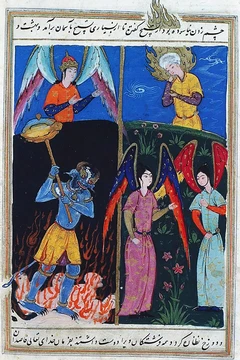
Saint Nedelya
Slavic personification of Sunday, punishing those who work on that day.
Saint Nedelya (St. Sunday, St. Anastasia) is a personification of Sunday as a day of the week in the folk Orthodoxy of the Slavs. She is correlated with Saint Anastasia and, among Bulgarians, also with Saint Kyriakia. Her veneration is associated with prohibitions against various kinds of work on Sunday, reflecting the Slavic origin of the word for Sunday from 'not to do.'
- also_known_as
- St. Sunday, St. Anastasia, Holy Week
- field
- Folk Orthodoxy, Slavic folklore
- associated_with
- Saint Anastasia, Saint Kyriakia, Paraskeva Friday
- venerated_in
- Slavic Orthodox traditions (Bulgarian, Belarusian, Ukrainian, Russian, Serbian, Croatian)
- known_for
- Personification of Sunday; punishing those who work on that day
Lore & Background
In Old Russian sources, sermons against paganism such as the 'Word about creatures and days of the week' and the 'Word of St. Gregory... How the first Gentiles worshipped idols' state that one should not venerate the image of the Week as a 'goon,' but rather 'Christ's resurrection.' The popular cult of Holy Week was also influenced by the translated apocrypha 'Epistle of Jesus on the Week,' which describes a stone falling from heaven in Rome or Jerusalem containing a scroll that prescribes righteous living and observance of Sunday, noting that the Annunciation, Baptism, Resurrection of Christ, and the Last Judgment occur on that day. Polish and Southwestern Russian copies of this apocrypha mention only the veneration of Week, while Great Russian copies also include Wednesday and Friday as venerable days 'by which the earth stands.'
Reader's Guide
Saint Nedelya represents a syncretic figure blending Christian saint veneration with pre-Christian Slavic personification of the day of rest. Her cult illustrates how the Church's prohibition of Sunday labor was reinforced through folk narratives that personalized the day as a female figure who actively punishes transgressors. The apocryphal 'Epistle of Jesus on the Week' provided scriptural justification, while local traditions varied: some Slavic regions emphasized only Sunday, others included Wednesday and Friday. The figure is closely related to Paraskeva Friday, with Serbs considering Friday the mother or sister of St. Week. The veneration of Saint Nedelya reflects broader Slavic patterns of personifying days of the week and linking them to moral and agricultural prohibitions, serving as a folk mechanism to enforce religious observance. Her legacy persists in folklore, spiritual verses, and the naming of places such as Sveta Nedelja.
Did You Know?
- The name 'Nedelya' derives from the Slavic 'ne delati' meaning 'not to do,' reflecting the prohibition of work on Sunday.
- According to Croatian beliefs, Holy Week was without hands, making it sinful to work on that day.
- In the apocrypha 'Epistle of Jesus on the Week,' a stone falls from heaven in Rome or Jerusalem containing a scroll that prescribes Sunday observance.
- Serbs believe that Paraskeva Friday is the mother or sister of St. Week, linking their feast days on October 28 and 29.
More in part-1
Spotted an error? Know more?
This is a living reference — every entry is fact-audited, and reader corrections feed straight into our audit queue. Suggest an edit · See this site's audit record